Operation OpenClaw
Kill Chain Analysis of an AI Agent-Driven Cyberattack
🎙️ Explainer Podcasts (6 Episodes)
Listen to detailed discussions about Operation OpenClaw available in multiple languages and technical levels.
🎥 Explainer Videos
Synthetic video presentation for a non-technical audience.
The Fall of PharmEurys (EN Non-Tech)
A Queda da PharmEurys (BR Non-Tech)
Fabrice Pizzi — Université Paris Sorbonne, 2026
Or download everything as ZIP.
Start Here
[NEW] New to AI Security?
Master 2 course (Sorbonne) — introduction to AI & Cybersecurity (updated to v8 with AI Attack Taxonomy and Autonomous Agents Risks).
Summary Note (~10 pages)
Academic overview of the full kill chain and defense model.
[STUDY] Agents of Chaos
Exploratory red-teaming study of autonomous LM-powered agents in a live environment.
The 5 Phases — Detailed Analyses

| Phase | Title | Timeline | FR Report | EN Report |
|---|---|---|---|---|
| 1 | Reconnaissance | D-30 → D-15 | ||
| 2 | Weaponization | D-15 → D-7 | ||
| 3 | Delivery & Exploitation | D-7 → D | ||
| 4 | Lateral Movement & Persistence | D → D+5 | ||
| 5 | Exfiltration & Double Extortion | D+5 → D+6 |
Interactive Infographics
Explore the visual breakdown of each kill chain phase.
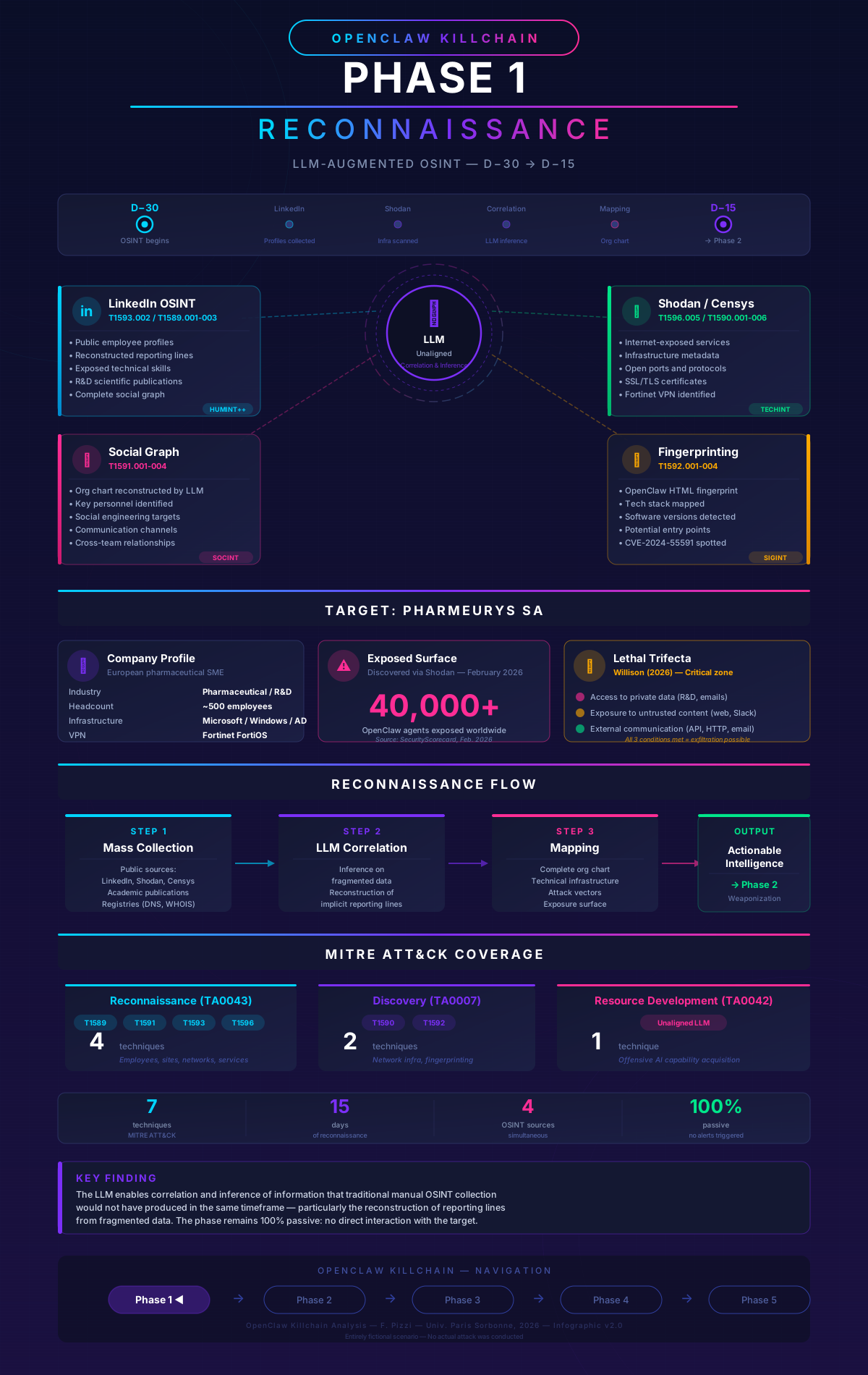
Defense-in-Depth Model (5 Layers)
| Layer | Principle | Key Controls |
|---|---|---|
| C1 — Agent Governance | The LLM is an advisor, not an executor | Tool allowlists, sandbox, human-in-the-loop |
| C2 — Input Control | All ingested content is untrusted | Data/instruction separation, need-to-know |
| C3 — Output Control | Legitimate HTTPS can mask logical abuse | Egress proxy, DLP, destination allowlists |
| C4 — Impact Reduction | Compromised agent must not inherit SI-wide permissions | Segmentation, 3-2-1-1-0 backups, AD hardening |
| C5 — Basic Hygiene | Agentic controls don't replace fundamentals | Accelerated patching, MFA, minimal exposure |
Core insight: Layers C4–C5 (fundamentals) would have disrupted the majority of the kill chain. Layers C1–C3 (AI-specific) are complementary, not substitute.
All PDFs, figures, and source files in a single download — no Git required.